
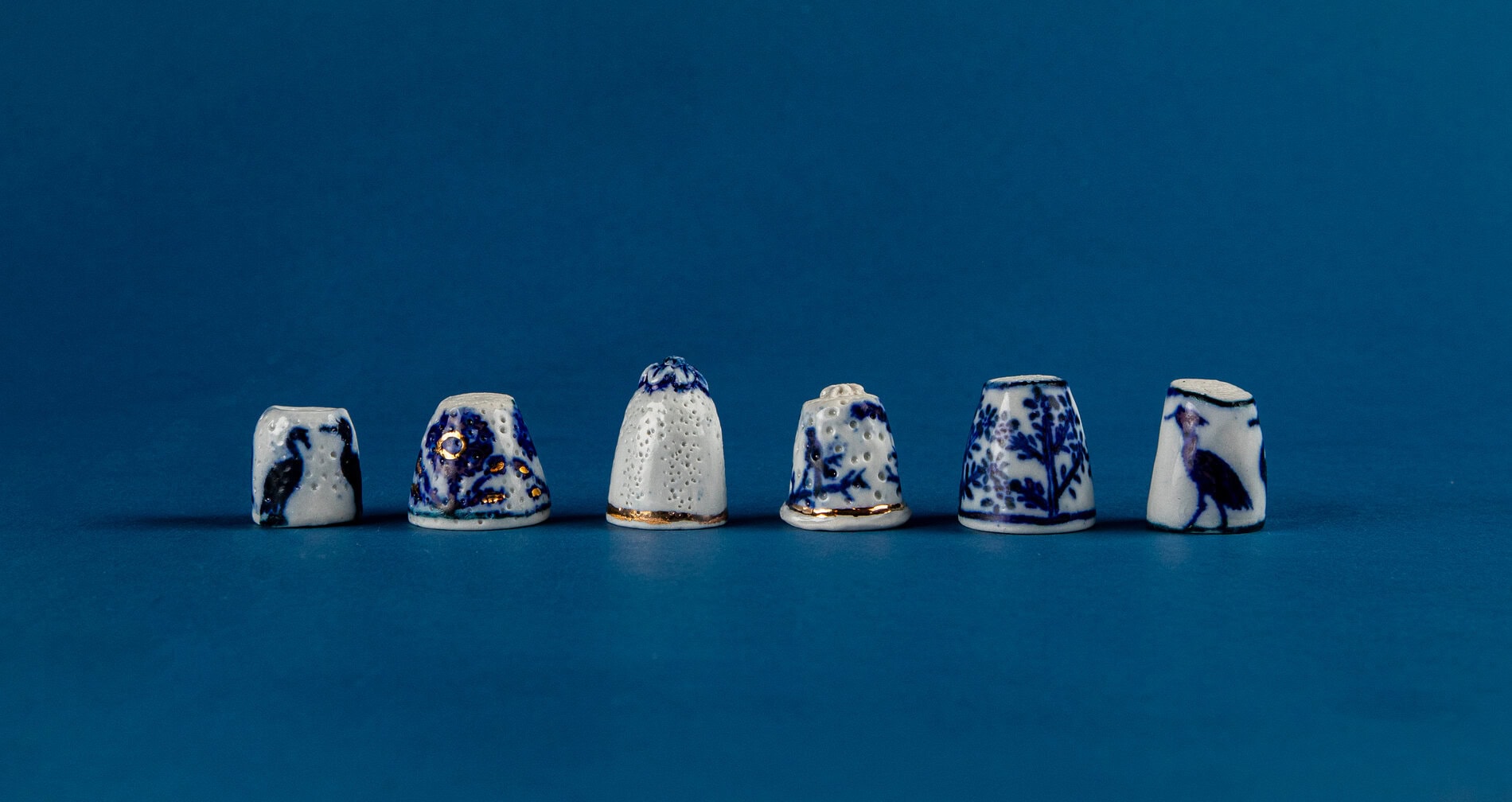
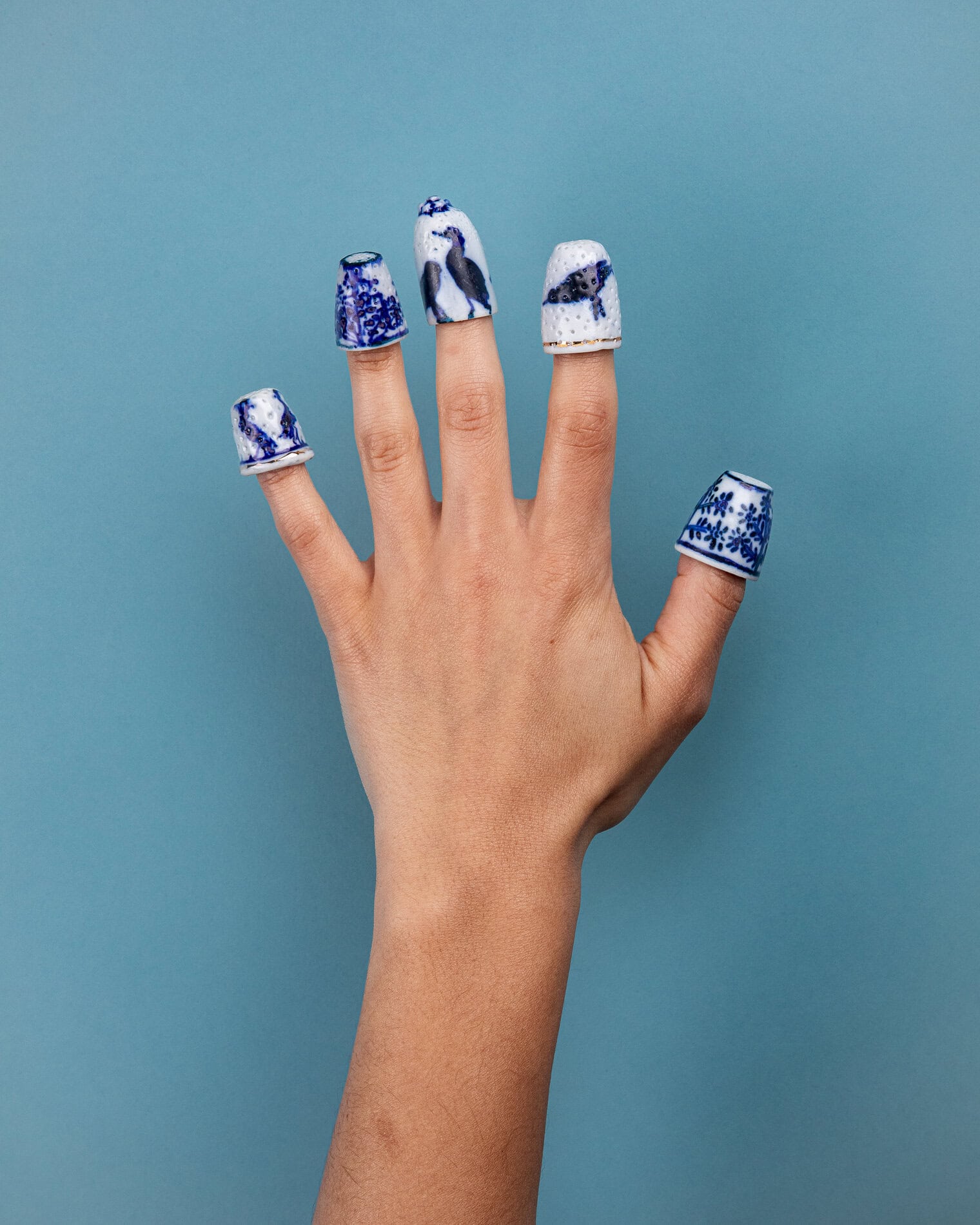
I’m sitting at my kitchen table, hand-sewing project in my lap. My right middle finger is capped snugly in a white, porcelain thimble. It feels cool to the touch. Winter sunlight streams in, and the thimble responds with a reflective glow. I admire the hand-painted birds dancing around its perimeter, and how its purposeful texture cradles my needle. It is a one-of-a-kind heirloom thimble, part of a series made by artist Melissa Goldstein, for TATTER.
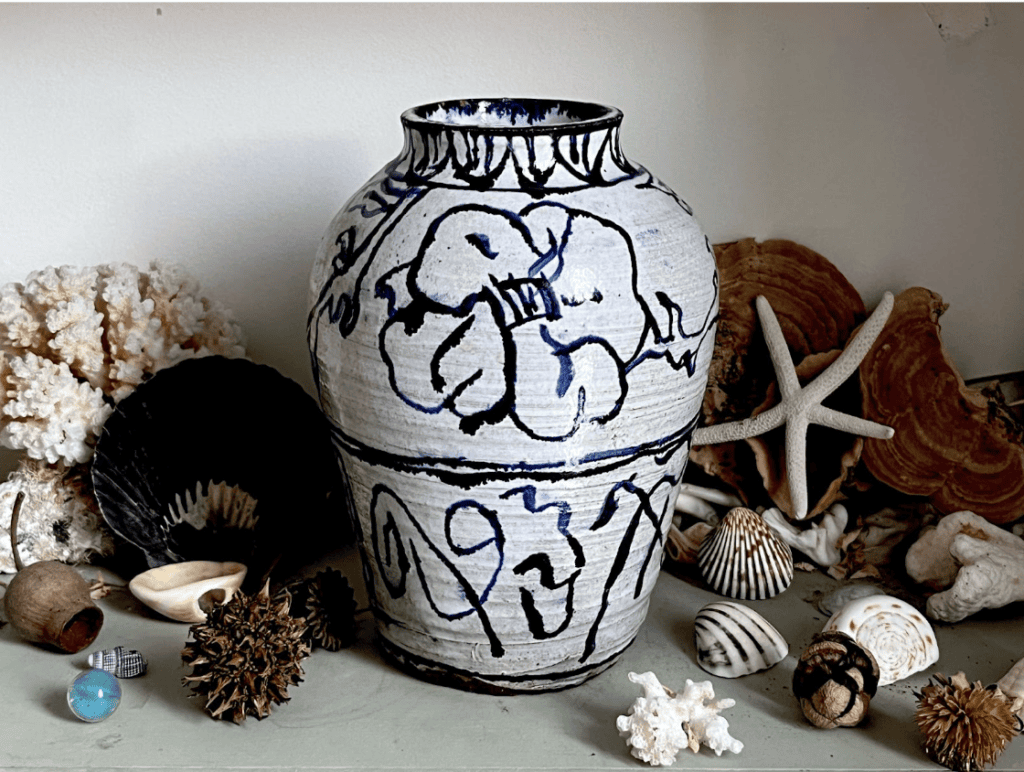
Stacked porcelain vessels of varying shapes, embellished with fine-lined, cobalt drawings of birds, flowers, and geometric patterns, are central to artist Melissa Goldstein’s ceramic practice: Mg by hand.
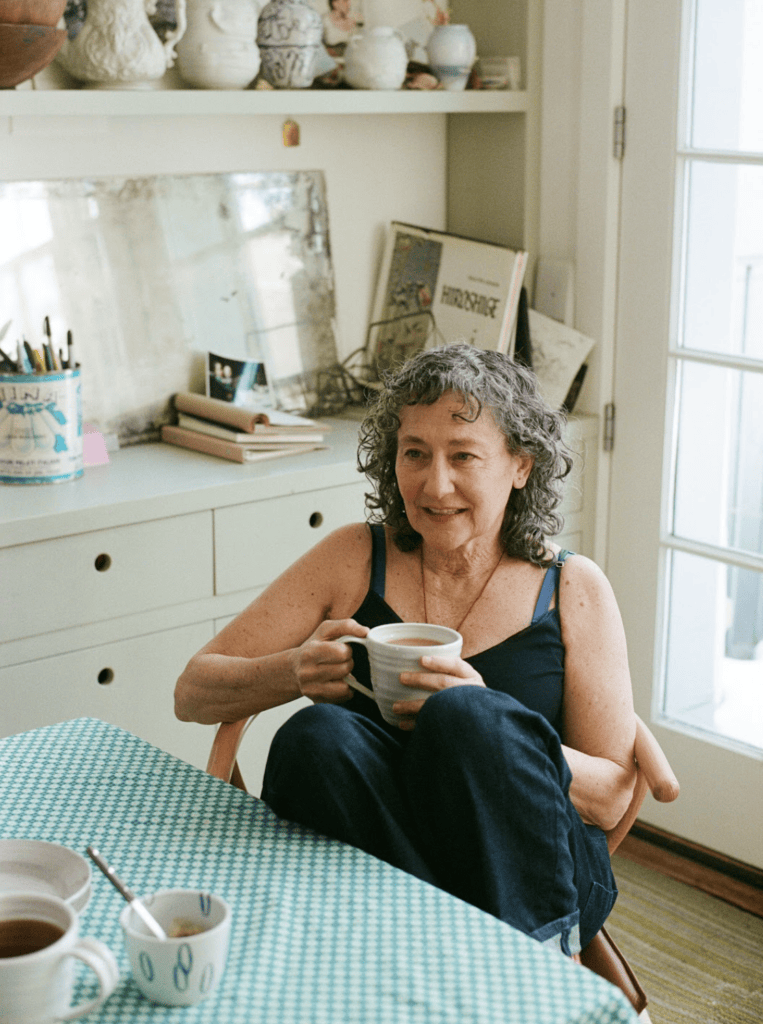
Melissa’s creative roots are in sculpture and installation, and when we meet over zoom she shares anecdotes about her formative years in art school, where her work was often collaborative. She worked in a group exploring movement through place and space.
I am an artist myself, and a collector of Melissa’s work, choosing to drink from her mugs and arrange flowers in her vases. Our shared art school backgrounds and my exuberance over what she creates make for easy, tactile conversation. Words like ‘liquidy, stacking, spherical, and heirloom’ are thrown around like the clay on her wheel, and begin to form the solid shape of my newfound understanding of her work.
“The TATTER x Mg thimbles are like single-stem bud vases turned upside down, in which the stem is our own working finger. Like their larger vase cousins, they are heirloom vessels, beautifully anticipating and cradling the future creativity of the user.“
Why porcelain? Why blue? Why birds? Vases? Asking an artist to pinpoint the intersections of her creative life is always a fascinating, archaeological reveal. When clay can become any shape and color, it seems obvious to inquire as to why Melissa, given her technical knowhow, limits her work to clear, glazed porcelain painted with hairline brushstrokes of deep blue.
Melissa worked with clay as a child, and has continued to work with it in different ways since. After a long time exploring the medium through sculpture and installation, she returned to tableware following the passing of her sister, Jessica. The two women were incredibly close and the loss profound. The tableware became a place to process the grief.
Always her champion, Jessica kept many things made by Melissa, most importantly a blue and white vase made at age 11. Melissa had not even remembered the vase until it found its way back to her following the loss. But it was a marvel. Before Melissa had even seen the world, her personal creative vision had anchored itself. Today, her body of work is a kind of return to that anchor.
Melissa’s creative practice began with drawing, and that natural tendency drives much of her work today. She loves the cream-cheesy feel of the porcelain clay body when it’s wet. She loves its physical challenges, and tries to push the limits of how much clay she can wield.
The resulting works are embellished with glorious geometries and floral motifs. The artist’s hand, her drawing practice, is always present. The forms, too, are of the hand, a little bit organic. Their subtle tilts are expressive, transforming the inert shapes into vessels which anticipate, as though listening for the approach of water and stems.
The artist’s large garden also factors in. Gardens prompt drawings of flowers, and lead to flower arranging—hence the vases. She also draws on the concept of gathering around a table. Gathering, eating, and drawing around a table has been a social constant for Melissa. She associates those moments with laughter and chatter, people getting up and sitting down. It’s a lively setting that animates the otherwise static tableware. Painted birds landing and taking flight from the pieces pay homage to that ritual.
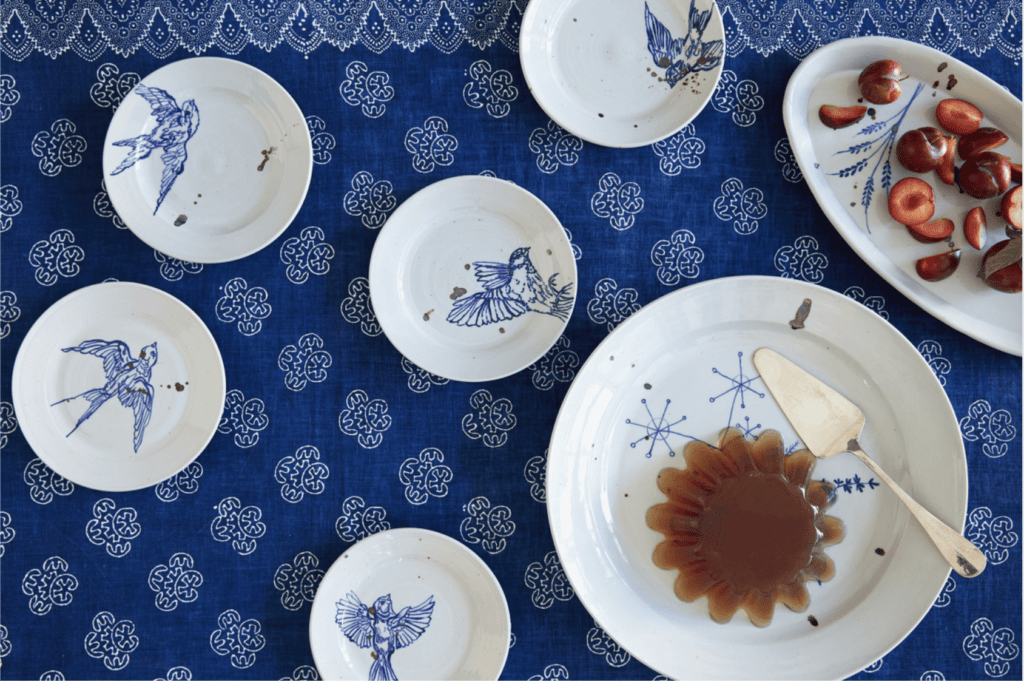
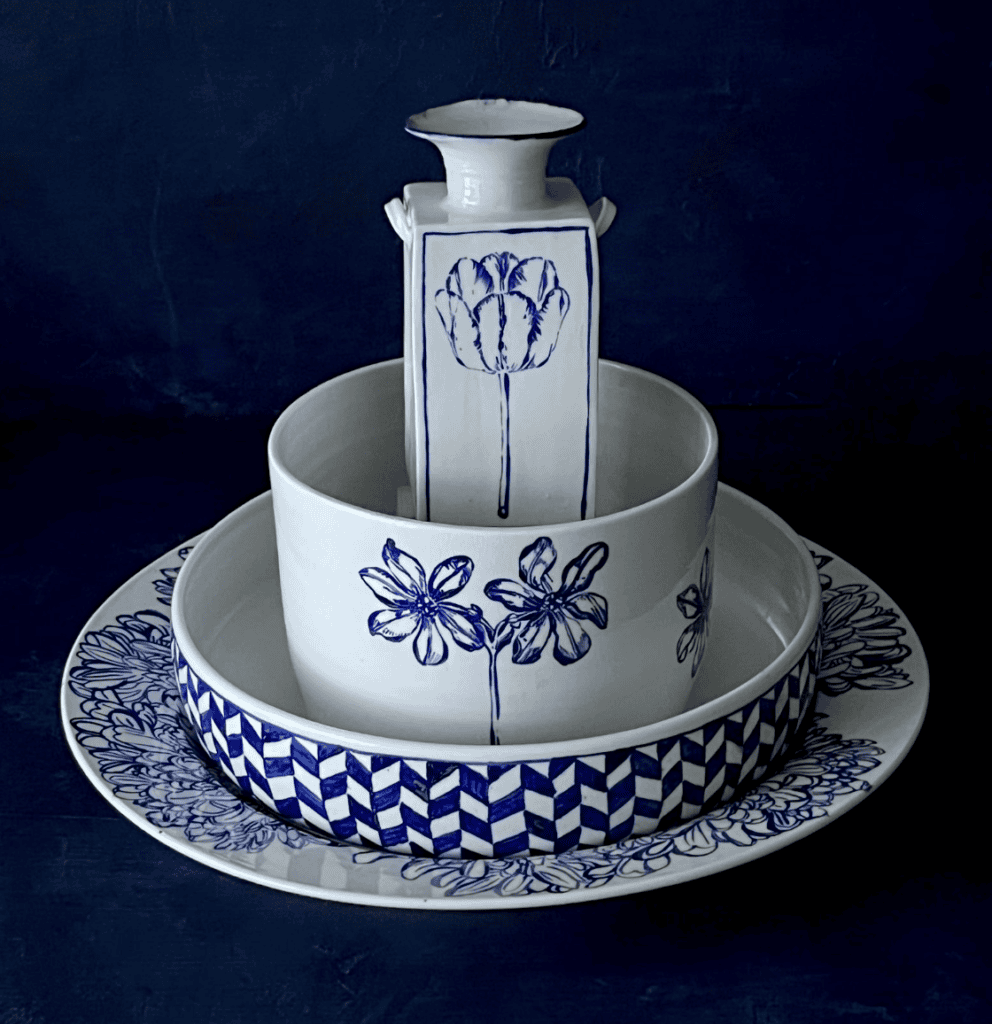
Of late, Melissa is thinking actively about stacking, building her pieces with the intention of nesting them one inside the other. Her art school ideas of inhabiting and moving through space rear their heads once more. We live with objects and shelves. We compose tableaux consciously and unconsciously. In our homes, we tidy and beautify and try to save space. As a result, we stack. Flower-arranging isn’t so different from shelf-arranging, and as the artist builds her vases to preempt that future, she now builds pieces in preparation for later stacking. Her anticipatory details honor us and our future work—even the simple expression of self in composing a shelf.
Last Autumn, we asked Melissa to contemplate making us a batch of porcelain thimbles, inspired by a blue and white Limoges piece from our collection. Ideas took root and bloomed into a wondrous garden of tiny, perfect, wearable tools. True to form, they bear the signature MG by hand cobalt, with varying arrays of flowers, geometries and birds. Each one is unique.
The TATTER x Mg thimbles are like single-stem bud vases turned upside down, in which the stem is our own working finger. Like their larger vase cousins, they are heirloom vessels, beautifully anticipating and cradling the future creativity of the user.


