
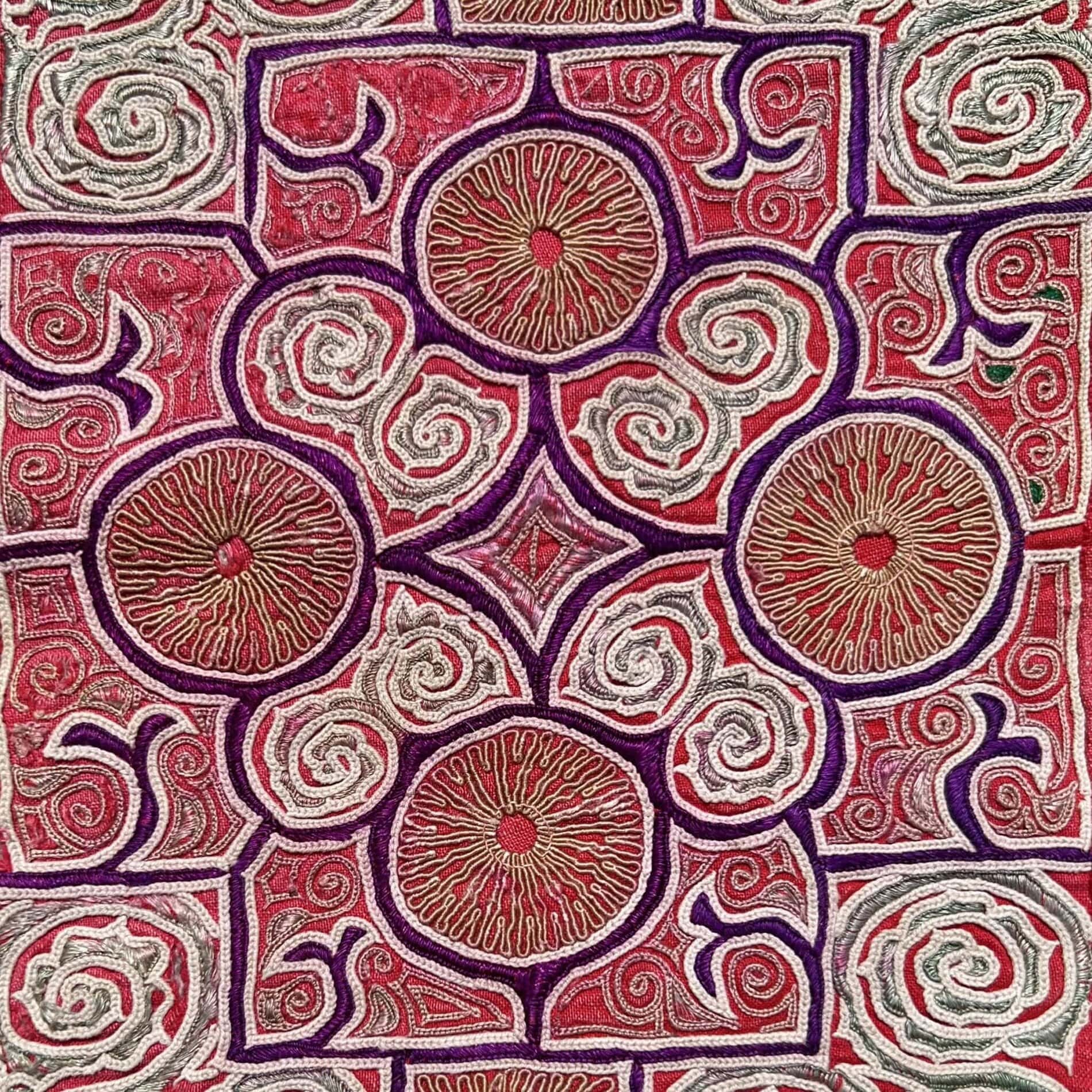
The Miao, an ethnic minority group living in deep mountains of the most remote areas in Southwest China, who have no written language, have been using their textile patterns to record cultural information and history for over two thousand years. With more than 100 clans, each Miao clan has their own costume code so that they can be identified easily. Such cultural code is handed down from generation to generation among Miao women, who make works of art inspired by traditional Miao songs and legends.
In this class, Selina will walk you through the brilliant textile heritage of the Miao. She will present images of historical Miao costumes and baby carriers and talk about Miao traditional patterns and material culture. She will also discuss the changes that Miao embroidery has undergone and Miao artists’ contemporary practice.
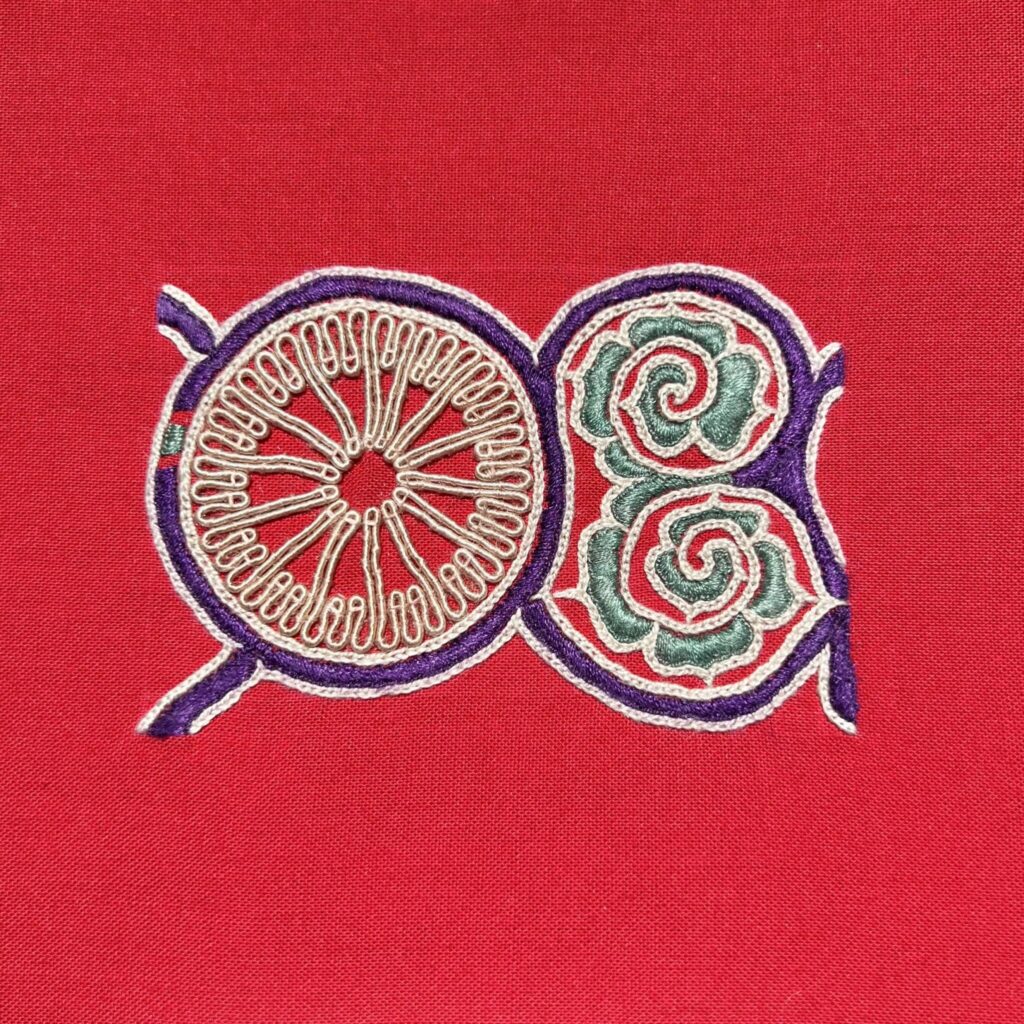
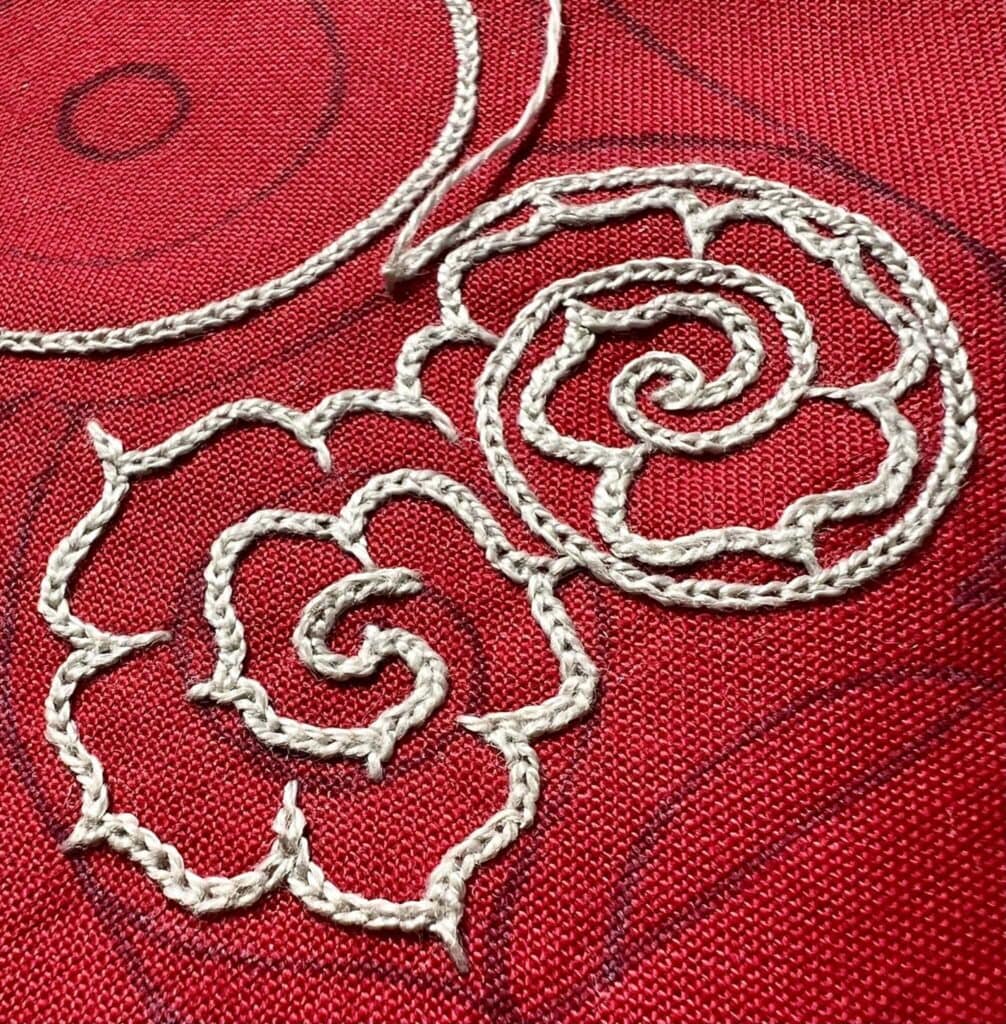
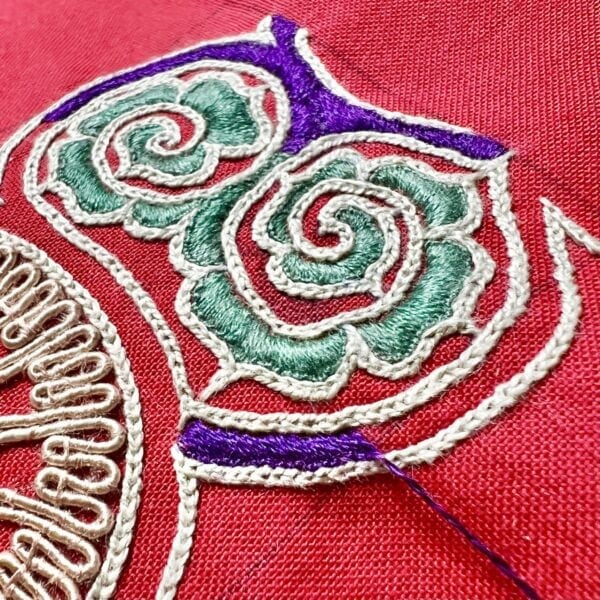
You’ll have the opportunity to learn Jiaoxiu, an ancient Miao embroidery technique which means embroidery with decorative wrapped thread. Traditionally Miao women wrap a cotton core thread with silk threads by hand, which is a very time consuming and complex process. Selina will invite you to experiment with a simplified approach of using commonly available ready-made gimp, which is accessible to today’s makers. You’ll learn how to embroider a traditional motif extracted from a stunning Miao baby carrier from Zhijin, a county in the middle of Guizhou province in China, where 48% of its population are ethnic minorities including Miao.
A PDF design pattern will be shared one week before the class for participants to transfer the design pattern to the fabric before the class, so that during the class we can focus on the stitching techniques.
Date
Thursday, May 7th, 2026
Time
12:00-2:30 pm ET
Location
Zoom, a link will be sent to participants the day before class
Cost
$75
Recording
All World Embroidery Series sessions will be recorded. A link to each recording will be emailed to all registrants following the live session. Each link is live for three months after the live session.
Class Materials:
- Base fabric top layer (minimum dimension 17x14cm): quilt-weight non-stretch woven cotton fabric, preferably in color red.
- Base fabric bottom layer (minimum dimension 17x14cm): loosely woven non-stretch cotton fabric. It should be heavier than quilt-weight cotton. Azumino-Momen Sashiko fabric is preferred. Wash, dry, iron all fabrics in advance to avoid shrinkage and color bleeding.
- Fusing material: Mistyfuse sheer fusible web in white. The 2 layers of base fabric should be fused together before transferring the design pattern. Separate PDF instruction on how to fuse the fabrics will be shared one week before the class.
- Cotton thread for chain stitch: DMC pearl cotton size 12. Color 644 is used on sample.
- Silk thread: Au Ver à Soie Soie d’Alger. Green (5024) and dark purple (3336) are used for blanket stitch, and dusty pink (2578A) is used for couching on sampler.
- Gimp for couching: Painters Threads rayon gimp from Tentakulum. Color Suricata is used on sampler. Alternatives: Stef Francis viscose gimp color V-34, Access Commodities filament silk gimp color 6263.
- Needle for gimp: Sue Spargo Gold Eye Milliners, size 15
- Needle for other stitches: John James Quilting Mi-Longues, size 5
- A pair of small, sharp scissors
- Heat erasable fabric marker in white
- Carbon paper for transferring design pattern to fabric: Olympus carbon paper. Use blue for light colored fabrics and white for dark colored fabrics.
- Iron
- Parchment paper
About the World Embroidery Series
TATTER’s World Embroidery Series is a celebration of global embroidery craft. Sewists will encounter an astonishing array of culturally specific techniques, and will have the opportunity to learn from accomplished practicing teachers who are equally purposed in preserving heritage techniques.
Our Teacher
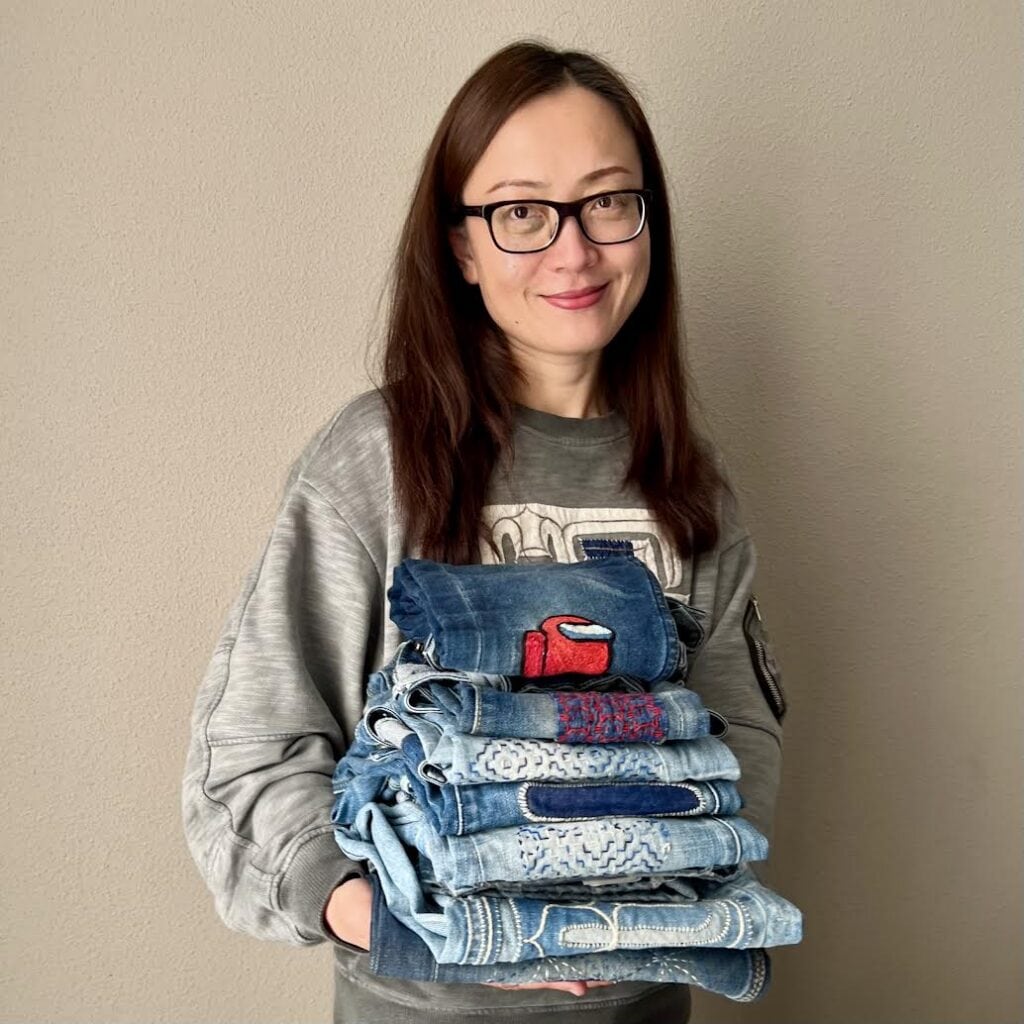
Selina Ben is a textile artist and mender based in Amsterdam, the Netherlands. With a professional background in textile product development, her passion for textiles has existed for as long as she can remember.
Selina is inspired by historical textiles around the world. Her curiosity about why the textiles were significant to a place, what materials were used and how they were made stimulates her creativity. With her practice, she hopes to preserve disappearing techniques, honor unknown makers and their cultural heritage.
Witnessing landfills overloaded with textile waste, Selina chooses to work with pre-used fabrics. All the signs of wear and tear on the fabrics are a source of inspiration for her creative process. With her hands, needles and threads, she brings the fabrics to a new phase of their lives so that people can start looking at our relationships with textiles differently.
Selina believes stitching by hand is the best form of meditation. The repetitive motions of arms, wrists, fingers, needle and thread bring peace of mind and a sense of accomplishment. As time goes by, the grounded feeling arises, the positive energy grows, and a new work is born.
Selina’s practice can be found at https://unwrittenstitch.com/ and Instagram @selinaam05.