
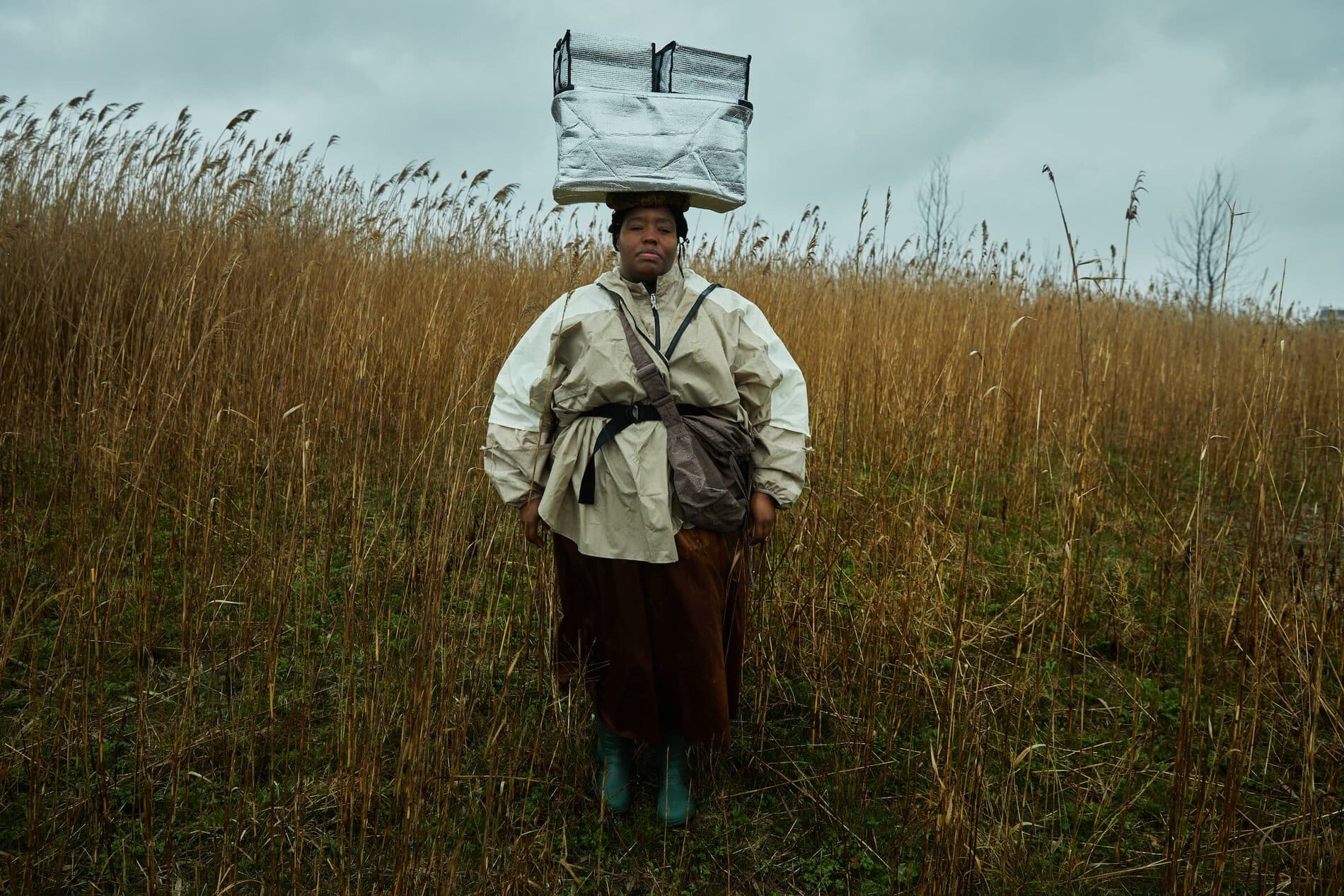
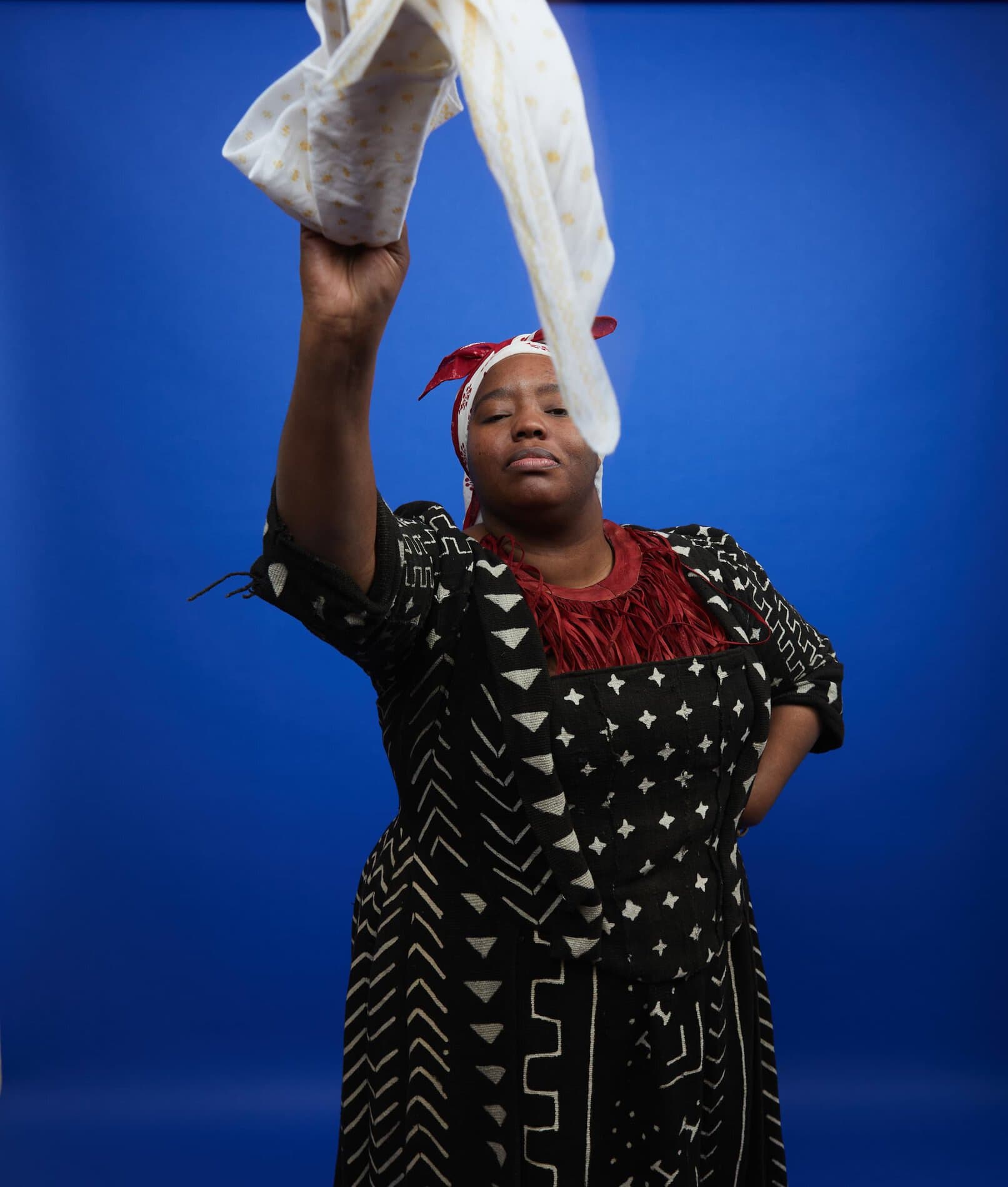
Cheyney McKnight is a performance artist who engages dress with a sense of reverence. Her dedication to embodying a Black woman living in the eighteenth and nineteenth centuries, specifically through cloth and hair, demonstrates how self-advocacy and expression have been integral to Black women’s lived experiences across centuries. McKnight uses everyday materials like denim as a site of experimentation. She elevates the material through reinterpretation and remixing, shifting its association with mundane labor to a collective cultural memory and form that honors the brilliance of diasporic dress. As seen, hues of blue morph into an elegant West African silhouette, the nuance of each fold defining and affirming a Black woman’s intimate relationship with her wardrobe and styling.
McKnight’s day-to-day ritual as a historical interpreter is intentionally situated at sites of colonial harm or the atrocities of slavery. She uses her body as a vessel to acknowledge the sacred privilege of occupying a duality of lived experiences and re-dress history on behalf of her lineage through thoughtfully constructed, bespoke ensembles. As she moves audaciously in her creative expression, her self-determination becomes an effective tool for haunting the enslaver’s descendants in the spaces she freely occupies. McKnight and her fellow Black interpreters find liberation and pleasure in intentionally reclaiming spaces where Black folks were historically denied leisure and rest. The clothing they wear activates a revision of antiquated narratives that overlooked the double subjugation and labor that Black women endured–harvesting and spinning the very clothes on their backs and that of others–all while fighting to be accepted as human vis-à-vis their white female counterparts and challenge systems of domination.
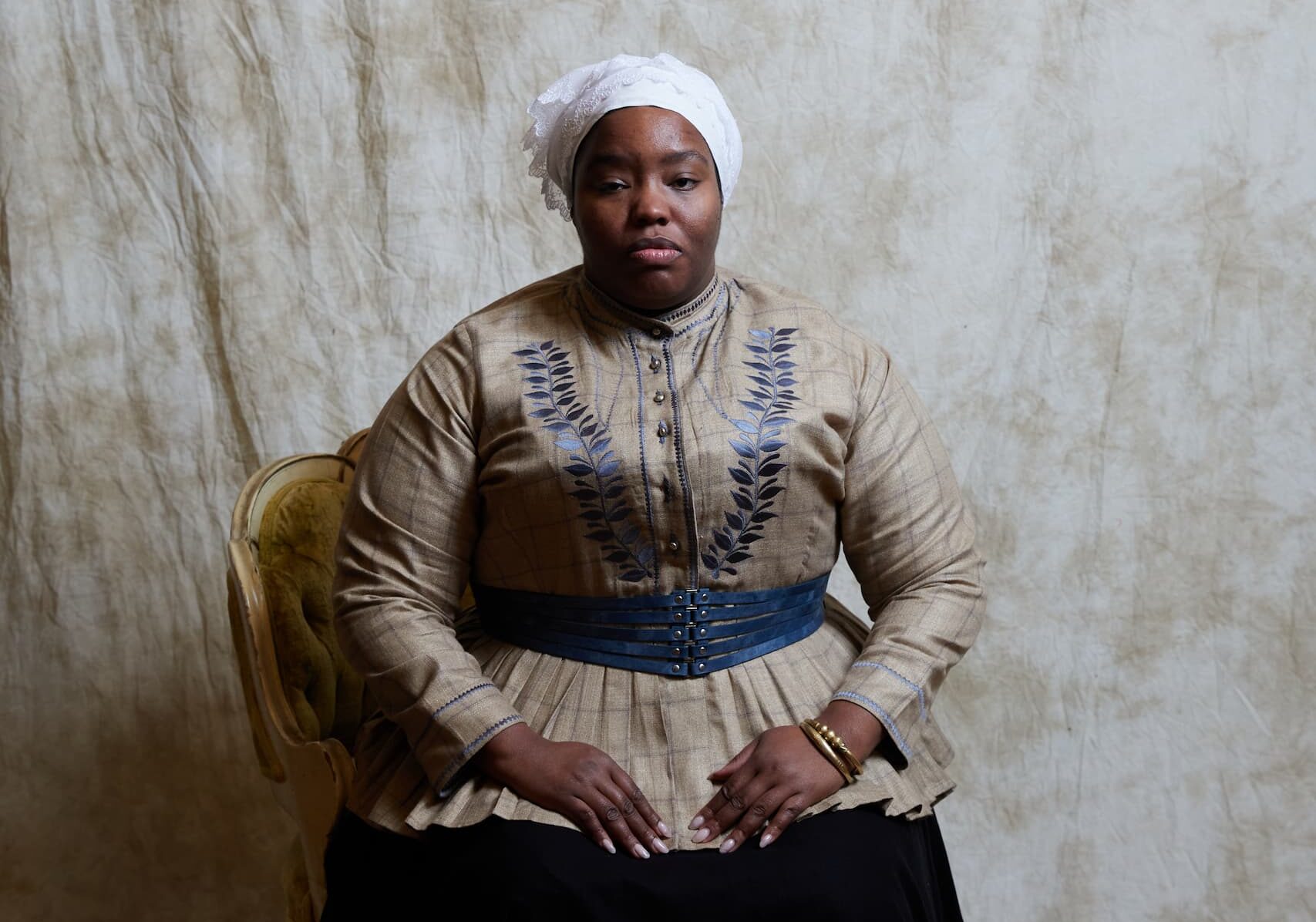
“[McKnight] uses her body as a vessel to acknowledge the sacred privilege of occupying a duality of lived experiences and re-dress history on behalf of her lineage through thoughtfully constructed, bespoke ensembles.”
“Through platforms like Not Your Momma’s History, [McKnight] incorporates elements of humor, personal experience, and contemporary references to create garments appreciated by her broad audience.”
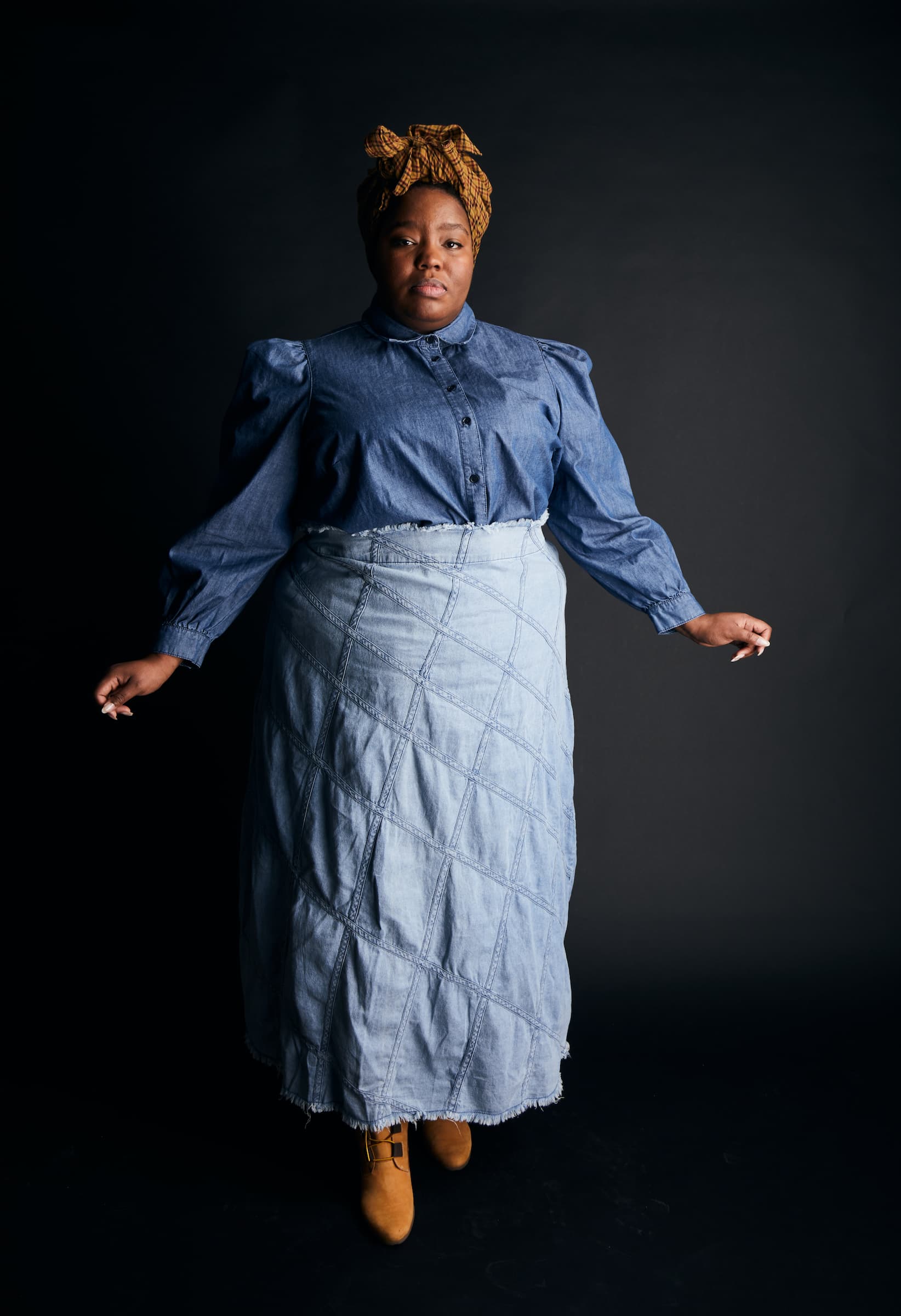
Originally committed primarily to replicating historical garments, McKnight shifted her focus over time: “I purposely thumbed my nose at historical accuracy. The idea that I’m more valid in telling a story because I have something as close, as accurate as possible is rooted in white supremacy.” Divesting from these limiting beliefs, she went on to build the spaces that could properly hold the depth of her interests and explore the role dress plays as a primary source for understanding Black life. Through platforms like Not Your Momma’s History, she incorporates elements of humor, personal experience, and contemporary references to create garments appreciated by her broad audience. Continuing to remain unrestricted in her practice, McKnight’s work is now evolving to incorporate Afrofuturism and its relationship with today’s social issues in more direct and challenging ways. Her exhibition at Dyckman Farmhouse (a frequent supporter of McKnight’s work), The Ancestors Future: An Afrofuturist Journey Through Time, aimed to spark dialogue and inspire action towards building a more equitable future. McKnight shared how she set the stage for her visitors, stating, “[For] my upcoming show, I’m going to be getting my hair done [and] getting my nails done in the parlor of a house of people who enslaved people that look like me. It really sets the tone for how they interact with that space.” Since the closure of McKnight’s exhibition, the very systems of oppression that her physical performances confront have now threatened the survival of Dyckman Farmhouse. The institutions that provide refuge and a platform for McKnight’s creativity have been directly affected by funding cuts from the Trump administration–a sobering reminder of how erasure of Black cultural memory is still alive and present. Her latest living installation, Living History: Clothing of Enslaved Women and Reclaiming Black Humanity at the New York Historical Society, engages children in particular, ensuring that the next generation carries on the truth that is woven into the fabric of United States history.
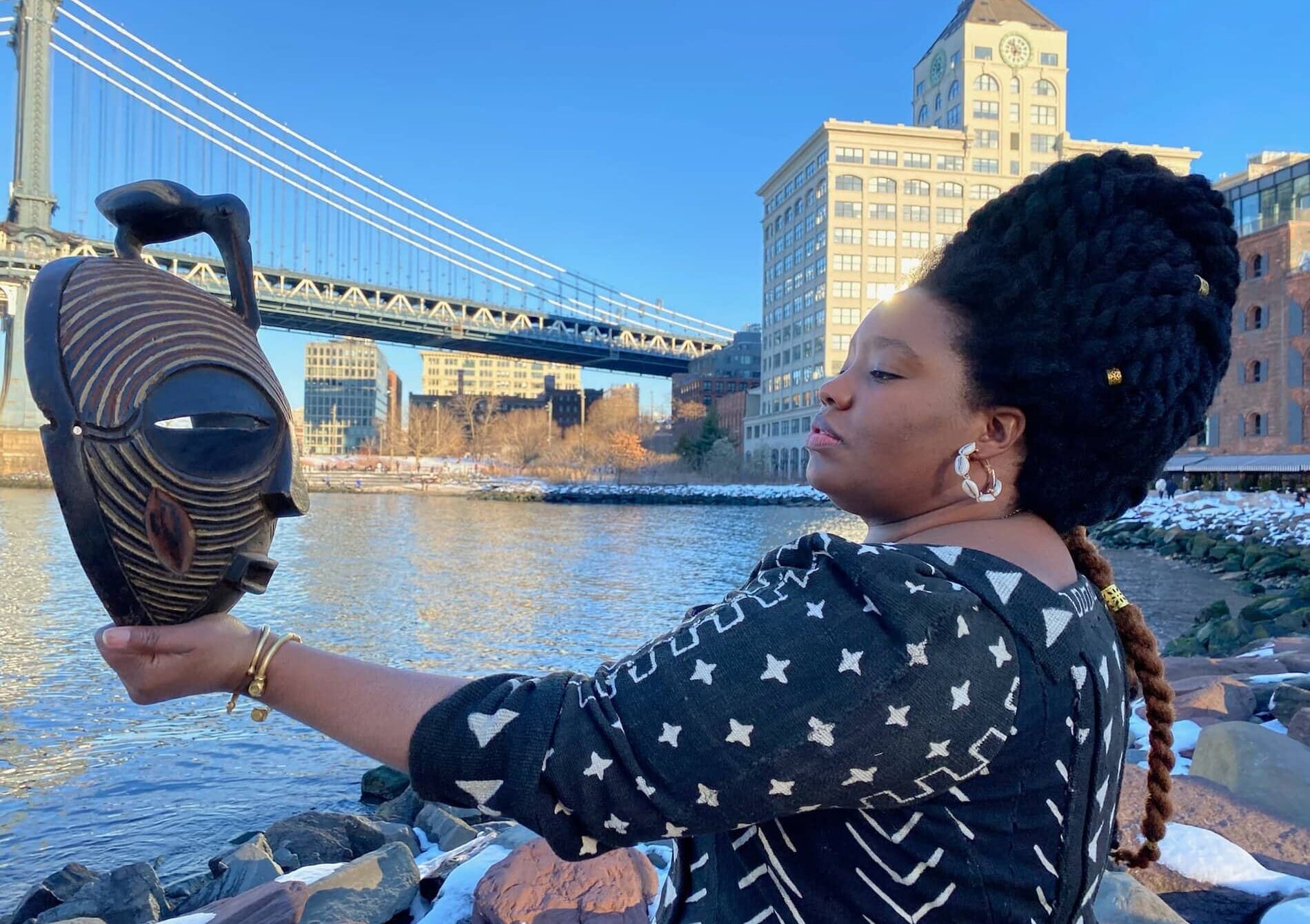
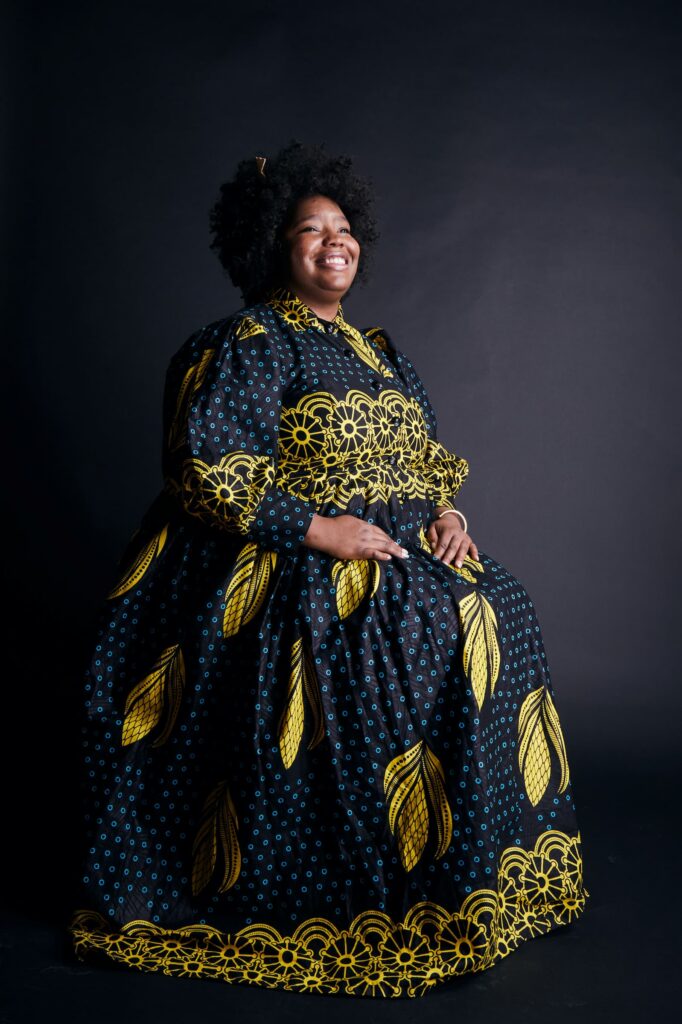
Cheyney McKnight is the founder and owner of Not Your Momma’s History. She advocates for interpreters of color at historical sites along the East Coast, providing them with much needed on-call support. She uses clothing and primary sources to connect past and present events through performance art pieces.
McKnight has taken her Let’s Talk About Slavery table to over thirty parks, historical sites, and public events across America to provide a safe place for people to learn and talk about the history of enslavement. McKnight’s work delves into a distant future while drawing on the past and present, illuminating the crucial role of Black bodies, health, and joy. McKnight was a 2021 National Trust for Historic Preservation African American Cultural Heritage Action Fund Fellow.
To learn more about the work of Cheyney McKnight, visit notyourmommashistory.com / @notyourmommashistory

Kimberly M. Jenkins is a fashion studies scholar and educator with fifteen years of experience in the fashion system. She is the founder and principal researcher of The Fashion and Race Database®, a globally licensed fashion education platform, and CEO of Artis Solomon, an academic advisory providing courses and bespoke research and insight about fashion history and theory.
Kim held faculty roles at Parsons School of Design and Pratt Institute in New York, and served as Assistant Professor of Fashion Studies at Toronto Metropolitan University before taking her work private. She is best known for launching the course Fashion and Race at Parsons and for consulting for Gucci (Milan and Hong Kong) on cultural awareness. In 2018, she won the “Outstanding Achievements in Social Justice Teaching” award at The New School.
A TEDx speaker, Kim has presented at Harvard University, the Fashion Institute of Technology, Georgetown University, the Museum of Fine Arts Boston, the Metropolitan Museum of Art, and institutions across Europe and beyond. In 2022, she partnered with Tommy Hilfiger to host and co-produce The Invisible Seam: Unsung Stories of Black Culture and Fashion. She also curated the exhibition Fashion and Race: Deconstructing Ideas, Reconstructing Identities, now hosted on Google Arts & Culture.
Kim’s expertise has been featured in The New York Times, The Wall Street Journal, Vogue Business, The Financial Times, The Business of Fashion, ABC News, and PBS American Experience, among others. She appears as a fashion historian and theorist in the PBS documentary Riveted: The History of Jeans and in an upcoming Amazon Prime fashion documentary.
To learn more about the work of Kimberly Jenkins, visit kimberlymjenkins.com / @kimberlymjenkins